
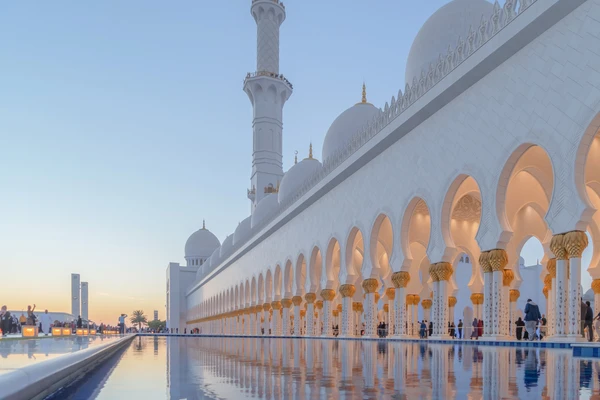
Let me tell you something that most visitor guides will not. Sheikh Zayed Grand Mosque is not simply Abu Dhabi's most visited landmark. For Emiratis, it is something entirely more personal. Sheikh Zayed bin Sultan Al Nahyan, the founding father of the United Arab Emirates, is buried in the mosque's courtyard. His presence is felt in every column, every dome, every tile underfoot. When I bring guests here, I am not showing them a building. I am sharing a piece of what it means to be from this place.
That said, this is also a practical guide. Admission fees changed significantly from September 2026, the dress code causes unnecessary anxiety for most visitors, and the difference between a rushed 45-minute visit and a properly paced three hours is the difference between seeing the mosque and actually experiencing it.
The Essential Facts
The mosque took twelve years to build and was completed in 2007. It can hold over 40,000 worshippers at full capacity. The statistics that most guides reach for: 82 domes, 1,000 columns, the world's largest hand-knotted carpet. All accurate. But the detail that stops guests cold is this: every single column is inlaid by hand with semi-precious stones. Mother of pearl, lapis lazuli, amethyst. Over 1,000 tonnes of Macedonian and Greek marble were used throughout the complex. None of this lands on a screen the way it does in person.
Admission Prices 2026
From September 2026, the mosque introduced a structured entry fee system replacing what had previously been free admission for most visitors. Below are the confirmed figures.
Sheikh Zayed Grand Mosque: Entry Fees
Effective September 2026My honest view on the optional extras
The Diya Light and Peace Museum at AED 25 is worth every dirham. It is an immersive journey through Islamic art, light and geometry that completely changes how you see the mosque afterwards. Most visitors do not know it exists. The Fast Track at AED 20 is genuinely useful on Friday afternoons and during UAE national holidays when queues exceed 40 minutes. On a weekday morning it is not necessary. The electric shuttle is pleasant but the grounds are walkable unless you have guests with mobility needs.
Opening Times
| Day | Opening Hours | Notes |
|---|---|---|
| Saturday to Thursday | 9:00am to 10:00pm | General visiting hours |
| Friday | 4:30pm to 10:00pm | Closed in morning for Jumu'ah prayer |
| Prayer closure times | Five times daily | Mosque closes approximately 30 min around each prayer |
Dress Code: Exactly What to Wear
This is the source of more visitor anxiety than anything else I encounter, and most of that anxiety is unnecessary. The mosque provides everything you need at the entrance free of charge.
👩 Women
- Full length clothing covering legs to the ankle
- Arms covered to the wrist
- Hair covered with a headscarf
- Any colour is acceptable, not only white
- Free abaya and headscarf available at the entrance
- Shorts or skirts above the ankle
- Sleeveless tops or bare shoulders
👨 Men
- Long trousers covering the ankle
- Sleeved shirt with shoulders covered
- Any colour is fine
- Smart casual is perfectly appropriate
- Shorts of any length
- Sleeveless vests or tank tops
- Flip-flops (you remove shoes, so bring socks)
Common myths I clear up every week
- You do not need to wear white. Any modest colour is perfectly acceptable.
- The abaya at the entrance is good quality and completely free. No pressure to buy anything.
- Men do not need to cover their heads.
- You remove shoes before the main prayer hall. Wear or bring socks.
- Bringing a bag or backpack is fine. The cloakroom is optional, not mandatory.
Can Non-Muslims Visit?
Yes, without any hesitation. Sheikh Zayed Grand Mosque has welcomed visitors of all faiths since it opened, and this is by deliberate design. Sheikh Zayed himself believed the mosque should be a place of dialogue and understanding between cultures, not a closed space. Non-Muslim visitors may enter all areas open to the public, including the main prayer hall, which houses the world's largest hand-knotted carpet and is one of the most extraordinary interior spaces anywhere.
The only requirement is respect: for the space, for worshippers who use it for prayer, and for the dress code. In all my years guiding here, I have never seen a visitor fail to feel that respect naturally. The mosque earns it the moment you walk through the gate.
Photography
Photography is permitted throughout the grounds and inside the prayer hall. Professional equipment and tripods require a permit from the mosque's media office. A smartphone is more than enough for most visitors. The shots worth planning for:
- The main dome from directly below. Stand in the centre of the prayer hall and look straight up.
- The reflecting pool at sunset. White marble reflects orange and pink sky in the water.
- The colonnade from the far end. 1,000 marble columns receding toward the horizon.
- The carpet detail. Get close. The craftsmanship is invisible in wide shots.
- The exterior at dusk. The illuminated domes against a darkening sky from the main approach.
How Long to Spend Here
Two hours minimum for a self-guided visit. Three hours with a guided tour or if you add the Diya Museum. The carpet alone, made by 1,200 craftspeople in Iran over two years, is worth 20 minutes of your time to walk its full length and notice how the colours shift in different light. Group tours that rush through in 45 minutes are doing guests a disservice.
How to Combine the Mosque With a Full City Tour
The mosque is the centrepiece of our Abu Dhabi Grand Mosque City Tour, which pairs the mosque with the Corniche, Qasr Al Hosn, the Emirates Palace area and Qasr Al Watan. Most guests spend the morning at the mosque then continue into the city for the afternoon. It is the most complete way to understand Abu Dhabi in a single day.
For visitors based in Dubai, the mosque is always the anchor of our Abu Dhabi city tour from Dubai. The drive is around 90 minutes and the mosque alone makes it worth the journey.
A Suggested Morning at the Mosque
Hotel pickup by your private guide
We collect you from your Abu Dhabi hotel and drive directly to the mosque, arriving before the main visitor wave.
Arrive at the mosque, entry pre-arranged
No queue at the ticket desk. Your guide collects the entry passes in advance. You walk in.
Guided tour of the mosque
The main prayer hall, the carpet, the reflecting pools, the minarets, the dome terrace. Mohammed or one of our team explains the history, the architecture and the personal Emirati connection to this place.
Diya Light and Peace Museum (optional)
30 to 45 minutes in the immersive museum on the mosque grounds. Completely changes how the preceding visit lands.
Continue to the city or return to hotel
Most guests continue directly to the Corniche for lunch, then Qasr Al Hosn and the Emirates Palace area in the afternoon.
Getting There
The mosque is on Sheikh Rashid bin Saeed Al Maktoum Road in the Khalidiyah area of Abu Dhabi, approximately 15 minutes from most central hotels by taxi. A taxi from the Corniche costs around AED 20 to AED 30. There is a large dedicated car park. From Dubai the drive is approximately 90 minutes. We include hotel pickup and drop-off in all our city tours, so transport is never something you need to arrange yourself.
Visit the Mosque With Someone Who Grew Up Next to It
Entry pre-arranged, dress code sorted, prayer times managed. Private vehicle, your pace.